Skin cancer is the most common form of Cancer in the UK, with over 100,000 new cases each year.

Your skin is your body’s first line of defence, which makes it extremely vulnerable to the environmental hazards of day-to-day life. Unfortunately, this makes Skin Cancer the most common cancer in the UK each year.
Early detection is key to effectively treating different forms of skin cancer, here is a guide on how to check your skin for signs of melanoma, basal, squamous, or Merkel cell carcinoma. If you have any inkling whatsoever that a mole or other discolouration could be cancerous, consult your GP immediately.
To stay ahead of skin cancer, you must familiarise yourself with every spot on your body. We’re talking about moles, freckles, age spots, or any other discolouration. Skin cancer can develop anywhere, so it’s important to be thorough when performing your inspection.
Stand in front of a full-length mirror and start by inspecting your front and back from head to toe. Next, inspect your right and left sides with your arms raised.
After you’ve looked at the highly visible places on your body, you’re going to need a hand mirror to get a view of the harder-to-reach places. Start with the back of your neck and scalp. Part your hair to ensure you get a good look at different areas on your scalp.
Next, check all of your nooks and crannies. Arms, elbows, palms, lower back, buttocks, legs, knees, and feet all need to be inspected closely with your hand mirror. If available, have someone assist you in looking at some of the harder-to-reach places.
Now that you’ve identified any and all dark spots on your body, how can you tell what’s cancerous and what’s not?
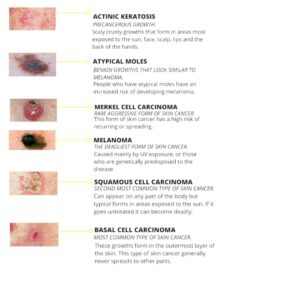
Melanoma is by far the most serious form of skin cancer. Fortunately, if caught early, it can be fully treatable.
When looking for melanoma, you should use the ABCDE method of inspection.
Asymmetry: Is one half of the spot larger or smaller than the other?
Border: Is the border of the spot irregular, blurred, or not defined?
Colour: Are the colours on the spot changing from one area to another?
Diameter: Is the spot larger than the size of a pencil rubber?
Melanomas typically are larger but can be smaller when diagnosed.
Evolving: Does the spot look different from other spots? Have you noticed a change over time?
If you exhibit any of these symptoms, consult your GP immediately for a professional screening.
Basal cell skin cancer is much more common and slightly less dangerous than melanoma and usually appears in areas that get a lot of sun (face, head, neck, shoulders, etc.).
Look for the following characteristics:
- Raised, irritated reddish patches
- Flat, stiff, pale or yellow areas resembling a scar
- A raised, glossy, semi-translucent pink, red, tan, black, brown, or white nodule
- Open sores that don’t fully heal or heal only to come right back
- Pink ring-like growths with raised edges and lowered centres.
- If found quickly, basal cell carcinoma can be easily treated.
Squamous cell carcinoma is the second most common form of skin cancer and, similar to basal cell cancers, squamous cell cancers tend to appear in areas that get a lot of sun. They can realistically grow anywhere but pay particular attention to these when checking your face, ears, lips, and hands.
Look out for the following characteristics:
- Scaly red patches with irregular borders
- An elevated growth with a depression in the centre
- A persistent open sore that bleeds and crusts
- A wart-like growth that occasionally bleeds
Merkel Cell Carcinoma, this form of skin cancer is rare (roughly 40x more rare than melanoma), but very aggressive and carries with it a high risk of spreading throughout the body.
The primary risk factors for this type of cancer include being over 50, being male, having fair skin, having plenty of UV exposure through the sun or tanning beds, having some form of immune suppression. Look out for the following characteristics: Firm, painless lesions, Red, blue, purple, or skin-coloured nodules about the size of 17mm.
For more advice see the guide below for photos from the Skin Scan Foundation or consult your GP. Please be aware this is information used to be more vigilant regarding skin conditions such as skin cancer and if you have any concerns to seek medical advice immediately.